~/portfolio — zsh
ahmed@ai : ~ $ whoami

Ahmed Dorra

ahmed@ai : ~ $ cat role.txt

_

ahmed@ai : ~ $ ./about --short

I build LLM applications end to end — hybrid-search RAG, tool-using agents with long-term memory, fine-tuned models and the FastAPI services around them — and I measure every change with evaluation, guardrails and monitoring. Published researcher and Computer Science teaching assistant.

ahmed@ai : ~ $ cat results.log
  • 23% → 43% right product ranked first, after adding reranking
  • 7 → 12 of 12 agent tasks passed, with 29% fewer paid rerank calls
  • 35 → 3.1 ms median vector search over 12,730 products
ahmed@ai : ~ $ ls quick_links/
01

About

I'm Ahmed, an AI engineer. I build LLM systems end to end — retrieval, agents, fine-tuned models and the services around them — and I treat every change as an experiment: define the metric, measure the baseline, change one thing, measure again. No demo-ware.

My route into AI was unusual. I started in quantum computing — as a remote research intern with QUAE (QWorld's UAE chapter) I built an EEG classification pipeline with a Quantum Variational Autoencoder, which became a published paper at the Neurogenomics 2024 conference. That experience taught me how to read papers, run rigorous experiments, and ship reproducible work.

Now I focus on what makes an LLM system dependable in production: evaluation that catches regressions, tracing that shows why an answer went wrong, guardrails tested against hostile input, and the latency and cost of every call. In my latest project a prompt change is only promoted after it beats the current version on the same tests, and every result is written down in an improvement log.

I like working across disciplines — from generative vision and quantum computing to language models. As a Computer Science teaching assistant I designed and led 50 Compiler Theory lab sessions for 600+ students and led tutorials in Linear Algebra, Calculus and Information Retrieval, which sharpened how I explain complex ideas simply.
02

AI Engineering Projects

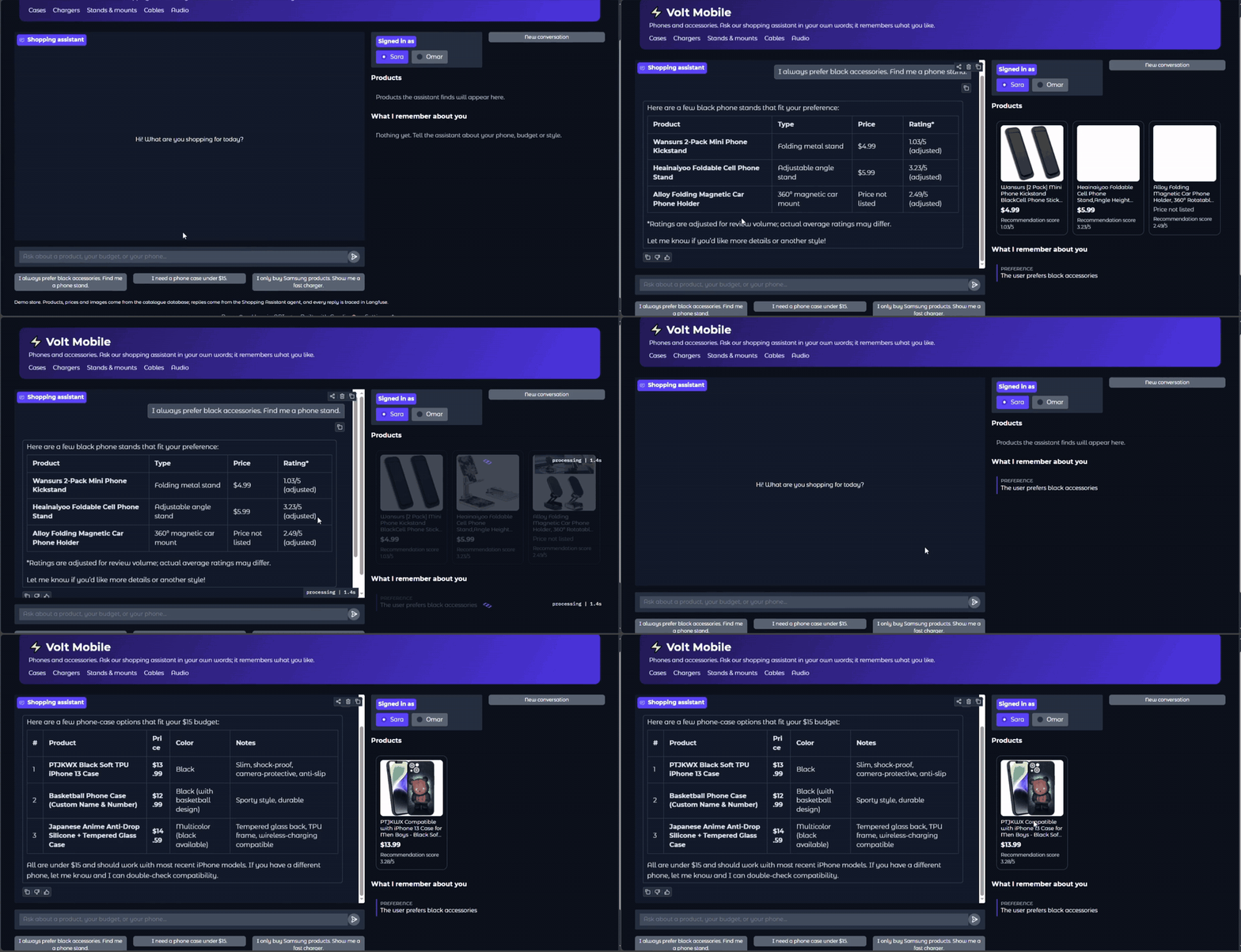
Three projects, each judged by numbers rather than demos. The Shopping Assistant has its own repository, the Research Assistant lives in my monorepo with a live demo on Hugging Face Spaces, and VISIONEER became a published paper.

Earlier work & experiments
03

Skills

LLM Systems & Agents

  • LangChain / LangGraph
  • RAG: hybrid search + rerank
  • Agents, tool calling & memory
  • Prompt design & versioning
  • Multi-provider LLM APIs

Evaluation & Observability

  • LLM & agent evaluation
  • Retrieval metrics (recall@k, 95% CIs)
  • Tracing & prompt management (Langfuse)
  • Guardrails & grounding checks
  • Experiment tracking (MLflow)

Production Engineering

  • FastAPI / Uvicorn
  • Docker / Compose
  • CI with GitHub Actions
  • Monitoring (Prometheus / Grafana)
  • Latency & cost optimisation

Retrieval & Data

  • PostgreSQL / pgvector
  • Chroma · BM25
  • Embeddings & rerankers
  • SQL
  • pandas / NumPy

Models & Fine-tuning

  • PyTorch
  • HF Transformers
  • LoRA fine-tuning (Diffusers)
  • XGBoost
  • scikit-learn

Languages

  • Python
  • SQL
04

Experience & Education

  1. Mar 2026 — Present

    Teaching Assistant, Computer Science

    Culture and Science City · Giza
    • Teach Advanced Operating Systems to 700+ students: processes and threads, CPU scheduling, synchronization and deadlocks, memory management and virtual memory, and file systems
    • Teach a starter MLOps course to about 500 students, modelled on DataTalks.Club's ML Zoomcamp: data preprocessing and cleaning, a linear model on a customer-churn dataset, an industry-standard project layout, MLflow experiment tracking, and serving with FastAPI and Docker
    • Assisted the supervision of two 2025/26 graduation projects: social-media trend and emotion analysis, and diabetes detection with machine learning
    • Designed and led 50 Compiler Theory lab sessions for 600+ students; co-taught neural-network and CNN sessions; set Distributed Computing quizzes; led Linear Algebra, Calculus and Information Retrieval tutorials
  2. Jan 2025 — Jan 2026

    Military Service (mandatory)

    Egypt
  3. Dec 2023 — Mar 2024

    Quantum Research Intern

    QUAE (QWorld UAE chapter) · Remote
    • Built a quantum machine-learning pipeline for EEG classification: a Quantum Variational Autoencoder for self-supervised denoising, followed by LDA for cognitive-task classification in brain–computer interfaces
    • Evaluated generalisation and computational-complexity trade-offs on noisy neurological time series; results published at the Neurogenomics 2024 Conference
  4. Oct 2023 — Jul 2024

    Diploma in Quantum Computing

    QWorld
    • Quantum algorithms, quantum machine learning and quantum information
    • QBronze, QSilver and QNickel certifications
  5. Oct 2020 — Jun 2024

    Bachelor of Science in Computer Science

    Culture and Science City · 6th of October, Giza
    • Relevant coursework: Machine Learning & AI, Software Engineering, Data Structures & Algorithms

Training & Certifications

MLOps Practitioner Course · MLOps MENA Community (2026) Mini-RAG: production RAG systems · Abu Bakr Soliman (2026) Hugging Face LLM Course · in progress Generative AI with Large Language Models · DeepLearning.AI Natural Language Processing Specialization · DeepLearning.AI Deep Learning Specialization · DeepLearning.AI Machine Learning Specialization · DeepLearning.AI & Stanford Applied Text Mining in Python · U. of Michigan Vector Databases (Pinecone) · 365 Data Science
05

Research

PUBLISHED · MACHINE GRAPHICS & VISION 2025

Fine-tuning Stable Diffusion for Generating 2D Floor Plans Using Prompt Templates

We fine-tune Stable Diffusion to generate 2D architectural floor plans from structured prompt templates, training on a curated dataset of floor-plan images spanning diverse design styles and layouts. The work pairs generative modelling with prompt engineering to turn natural-language descriptions into usable architectural drafts.

Machine Graphics & Vision, 34(3), 77–95 Read the paper
PUBLISHED · NEUROGENOMICS 2024

Quantum Denoising in the Realm of Brain-Computer Interfaces: A Preliminary Study

We explore how a Quantum Variational Autoencoder can denoise EEG signals before classification, evaluated on a brain-computer-interface task. Published at the Neurogenomics 2024 Conference; I built the quantum machine-learning pipeline (QVAE denoising followed by LDA classification) and evaluated its generalisation and computational-complexity trade-offs.

Neurogenomics 2024 Conference Read on HAL
06

Contact

Looking for an AI engineer who measures what they ship?

I'm open to AI engineering roles — in Egypt, remote, or relocating. Let's talk.

Download CV